How Parenting Time Percentage Affects Child Support
Your parenting time percentage directly impacts child support in most U.S. states. Here's exactly how the calculation works and what threshold triggers a reduction.
The number of overnights you have with your child doesn't just affect your relationship — it directly affects how much child support you pay or receive. In most U.S. states, parenting time percentage is one of the two biggest variables in the child support formula. Getting that number right matters.
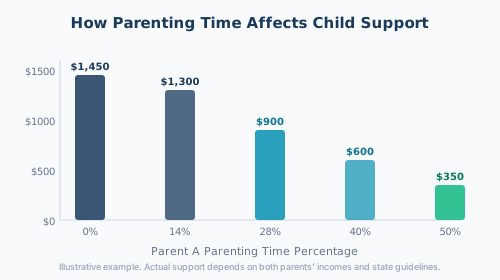
The Overnight-Based Standard
Before we get into the math, one important point: child support guidelines in most states use overnights, not waking hours or calendar days. An overnight is a night the child sleeps at a parent's home. This standard was established to create a clear, objective measure — one that's hard to dispute and easy to verify in a parenting plan.
The parenting time calculator uses this same overnight-based formula, producing the exact percentage figure you'll need for child support worksheets in California, Florida, Colorado, Illinois, Texas, and most other states.
How the Income Shares Model Works
Most states — 41 as of 2025 — use the income shares model for child support. Here's the basic structure:
1. Add both parents' gross monthly incomes together
2. Look up the "basic support obligation" for that combined income and number of children on your state's schedule
3. Divide that obligation between the parents in proportion to their respective incomes
4. Adjust for parenting time using your state's specific formula
The parenting time adjustment is where your percentage matters. Most income shares states reduce the support obligation when the paying parent's time exceeds a threshold. That threshold varies:
- California: Adjustment applies at any parenting time level, but the formula becomes more favorable above 20%
- Colorado: Significant reduction kicks in above 25% (91+ overnights)
- Florida: Overnights-based calculation applies when the non-majority parent has more than 20% of overnights (73+ nights)
- Illinois: Adjustment applies when the non-custodial parent has 146+ overnights (40%)
- Texas: Child support tables don't automatically adjust for parenting time, but judges have discretion above 35%
If you're near one of these thresholds, even a small change in your parenting schedule can have a significant dollar impact. Running those numbers through a parenting time calculator before finalizing your plan is worth the two minutes it takes.
A Worked Example
Say two parents in Colorado have a combined gross income of $8,000/month and one child. The basic support obligation from the state schedule is approximately $1,200/month. Parent A earns $5,000 (62.5%), Parent B earns $3,000 (37.5%).
Without parenting time adjustment, Parent A would owe: $1,200 × 62.5% = $750/month.
But if Parent A has 40% of overnights (146 nights), Colorado's shared custody adjustment significantly reduces that obligation — often by 30–40%. In this scenario, Parent A's obligation might drop to $450–$500/month depending on the state worksheet.
Shifting from 25% to 40% parenting time can save the paying parent $200–$300/month in a typical middle-income case. That's a real difference — and it comes from the overnight count.
The Percentage Threshold Problem
One of the most common mistakes parents make when negotiating parenting plans is not realizing they're one step below a significant threshold. If your state reduces support at 40% parenting time and you're currently getting 38% (139 overnights), asking for two more scheduled overnights per month brings you over the line.
This isn't gaming the system — it's informed negotiating. If those extra overnights genuinely benefit the child and both parents can make them work, including them is reasonable. The problem comes when parents pursue extra overnights only for the support reduction, then don't actually exercise the time. Courts notice this.
Documenting Your Parenting Time
If you have a parenting plan, courts use that document's schedule — not what actually happened — unless you can prove consistent deviation. This cuts both ways:
- If you're exercising more time than your order requires, that doesn't automatically reduce your support obligation
- If you're exercising less time, you may still owe based on the original schedule
When actual parenting time has significantly diverged from the order, you have two options: modify the order to reflect reality (which then affects support) or leave it as is. Most family attorneys recommend keeping the order current. Learn how to modify a custody order if your circumstances have changed.
Child Support and 50/50 Arrangements
A 50/50 parenting time split doesn't mean zero child support. Because support is based on both parents' incomes, the parent who earns more will typically still owe support — just at a reduced level compared to a primary-custody arrangement.
In a 50/50 custody arrangement where incomes are similar, support obligations may be minimal or even zero. But if there's a significant income disparity, the higher earner will still pay something — the parenting time reduction just makes that amount smaller.
State-Specific Resources
Child support guidelines are set by each state, and they change periodically. The National Conference of State Legislatures maintains up-to-date summaries of each state's model and schedule. Your state's official child support agency website will have the current worksheet and instructions for filling it out.
If the numbers matter significantly to your situation — and they usually do — consult a family law attorney in your state before finalizing any agreement. A one-hour consultation to verify your calculations is far cheaper than getting the numbers wrong in a settlement.
Getting Your Numbers Right
Start with the parenting time calculator to establish your current and proposed percentage. Take those numbers to your state's child support worksheet (available on your state's judicial website) and run both scenarios. The difference in support will tell you how much each schedule option is worth financially — and help you make an informed decision about what to negotiate.
Understanding the difference between parenting time and legal custody is also useful here: only physical custody (parenting time) affects support calculations. Legal custody — the right to make decisions — doesn't factor into the formula.