How Does 50/50 Custody Work? Schedules & Reality
A clear breakdown of how 50/50 custody actually works in practice — the three main schedule types, what 182 overnights looks like day to day, and when equal time makes sense.
A 50/50 custody arrangement means each parent has the child approximately half the year. In practice, that's around 182 overnights each. But "50/50" isn't a single schedule — it's a category, and the three most common versions feel very different to live with.
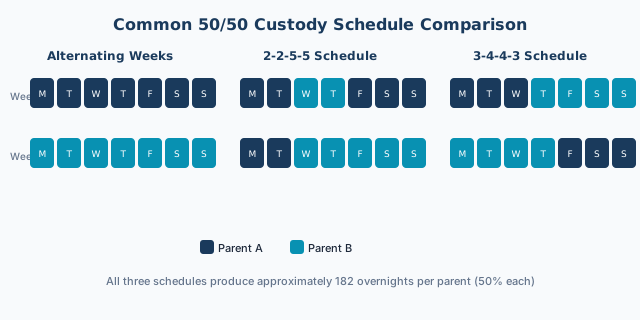
The Three Main 50/50 Schedule Types
Alternating Weeks
The simplest 50/50 structure: the child spends one full week with Parent A, then one full week with Parent B, switching every Sunday (or whatever handoff day works). Each parent has 26 weeks, producing exactly 182 overnights apiece.
Strengths: one transition per week, easy for everyone to track, good for older school-age kids who adapt well to longer stretches. Weaknesses: young children may struggle going 7 days without the other parent, and if one parent misses a handoff, it throws off two weeks.
2-2-5-5 Schedule
Parent A has Monday and Tuesday every week. Parent B has Wednesday and Thursday every week. Weekends alternate on a two-week cycle. The result: children never go more than 5 days without seeing either parent.
This schedule works especially well for younger children who benefit from frequent contact with both parents, and in high-conflict situations where fewer consecutive days reduces tension. The downside is more transitions — four times per week on non-weekend weeks.
Over a full year, the 2-2-5-5 produces 182 or 183 overnights for each parent depending on whether the year starts mid-cycle.
3-4-4-3 Schedule
Week one: Parent A gets 3 days (Monday–Wednesday), Parent B gets 4 days (Thursday–Sunday). Week two: Parent A gets 4 days (Monday–Thursday), Parent B gets 3 days (Friday–Sunday). Then the cycle repeats.
This schedule strikes a balance — fewer transitions than 2-2-5-5 while still ensuring neither parent goes more than 4 days without the child. Many mediators recommend it for families where the 2-2-5-5 creates too many pickups but alternating full weeks creates too long a separation.
What Does 50/50 Actually Look Like?
On paper, 182 overnights sounds even. In practice, the split rarely lands at exactly 50% once you factor in holidays, school breaks, and summer. Most parenting plans that call for "50/50" end up closer to 48–52% after you run the actual numbers.
That's why it's worth using a parenting time calculator before finalizing your agreement. Adding just two extra summer weeks to one parent's column shifts the split by about 3.8 percentage points — enough to matter for child support calculations in most states.
Is 50/50 Right for Your Family?
Equal time works best when:
- Both parents live within a reasonable school commute of each other (typically 20–30 miles or less)
- Both parents are capable of maintaining consistent routines
- The child is old enough to handle transitions — most family therapists suggest school age (5+) as a starting point, though younger children can do well with modified schedules
- Parents can communicate civilly about logistics
Equal time isn't automatically the best arrangement for every child. Courts in most states don't start from a presumption of 50/50 — they start from "best interests of the child." A parent who works rotating night shifts, travels frequently, or lives two hours from the child's school may find that a 60/40 or 70/30 split better serves the child's stability.
How Courts View 50/50 Requests
Most family courts look favorably on 50/50 arrangements when both parents are fit and willing. Research from the American Psychological Association consistently shows that children benefit from ongoing involvement with both parents, provided the relationship is not characterized by conflict.
What courts don't do: automatically grant 50/50 just because one parent demands it. Judges weigh the child's existing attachments, each parent's work schedule, school stability, sibling relationships, and — for older children — the child's own preferences.
If you're negotiating a 50/50 schedule, come prepared with a specific plan (not just "I want half the time"), a realistic logistics proposal, and documentation that you've been actively involved in the child's daily life — school pickups, medical appointments, extracurriculars.
Child Support and 50/50
Even in a true 50/50 arrangement, one parent often still pays child support. Why? Because child support in most states is based on both parents' incomes, not just parenting time. If Parent A earns $90,000 and Parent B earns $40,000, the higher earner will likely owe support regardless of the equal time split.
That said, parenting time is a significant factor. In California, Colorado, Florida, and most other states using the income shares model, a 50/50 split generates a noticeably lower support obligation than a 70/30 split — often hundreds of dollars per month less. See how parenting time percentage affects child support calculations in different states.
Modifying a 50/50 Order
If your 50/50 arrangement isn't working — one parent has relocated, the child's needs have changed, or one parent consistently isn't exercising their time — you can petition for a modification. Most courts require a "substantial change in circumstances" to reopen a settled custody order.
Document everything before you file: missed exchanges, the child's expressed preferences (if age-appropriate), changes in each parent's work schedule or living situation. Learn how to modify a custody order and what courts look for when deciding whether to approve a change.
Putting It Together
A 50/50 custody arrangement is a reasonable goal for many separated families. The schedule type you choose matters as much as the equal-time goal itself. Run your proposed schedule through the parenting time calculator to confirm you're actually hitting 50% — or close to it — after holidays and summer are factored in. Then review the resulting numbers with your attorney or mediator before signing anything.